Sweg Motor Sweg Motor

Why Choose Coreless DC Motors Over Standard Ones in 2026?

Time:2026-10-05 Author:Mason
0%

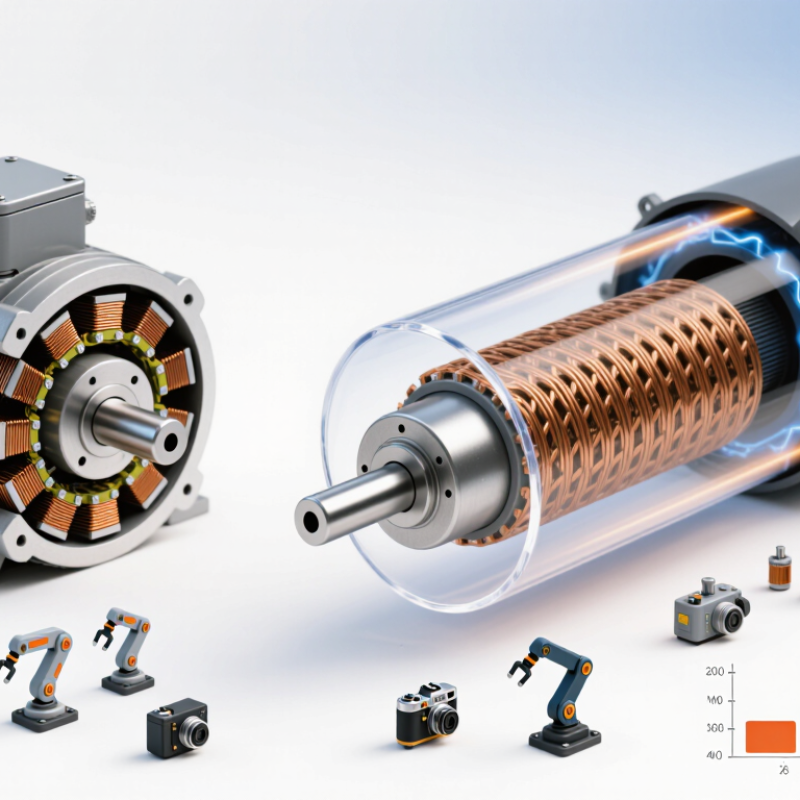
In 2026, engineers are asking a sharper question: why use a coreless dc motor instead of a standard one? The answer begins inside the rotor. A coreless motor replaces the conventional iron core with a lightweight, self-supporting winding. This design reduces rotor inertia, electromagnetic losses, and mechanical vibration. It can accelerate a miniature pump within milliseconds, stop cleanly, and deliver precise motion in medical instruments, robotics, cameras, and laboratory equipment.

The International Energy Agency reports that electric motor systems consume roughly 46% of global electricity, making efficiency and control increasingly important. Market research from MarketsandMarkets also identifies compact, high-performance motors as a growing requirement across automation and healthcare equipment. However, coreless technology is not automatically superior. It may cost more, require careful thermal management, and provide less continuous torque than a larger iron-core motor. That trade-off matters.

Dr. Fritz Faulhaber, whose company pioneered the modern coreless micro motor, described the principle clearly: “The ironless winding permits high acceleration and deceleration.” That statement still guides practical design decisions. A lower-inertia rotor feels like a lighter flywheel in the hand. It responds faster, wastes less energy during repeated starts, and improves closed-loop positioning. Yet selection should follow measured duty cycles, not marketing language. Engineers should compare torque, temperature rise, lifetime, noise, controller compatibility, and total system cost. Sometimes, the standard motor remains the wiser choice. The best answer depends on the application.
Why Choose Coreless DC Motors Over Standard Ones in 2026?

Coreless DC Motor Architecture: Ironless Rotors and 10–100× Lower Inertia

Why Choose Coreless DC Motors Over Standard Ones in 2026?

Coreless DC motors replace the conventional iron rotor with a lightweight, ironless winding structure. Removing the core cuts rotating mass and eliminates magnetic cogging. In practical designs, rotor inertia can be 10–100 times lower than standard iron-core motors, according to comparative engineering data published in the motion-control industry. That difference is visible on the test bench: a small actuator reaches position quickly, reverses with less delay, and needs less energy to correct overshoot.

Speed matters more now. The International Federation of Robotics reported 541,302 industrial robots installed worldwide in 2023. Many compact joints require fast, repeatable movement, not merely high continuous torque. Coreless designs can support this response because the controller accelerates less rotating mass. The result may include sharper camera stabilization, quieter medical instruments, and more precise miniature grippers. Less vibration helps.

There are compromises. The air-core winding usually stores less heat, so continuous overload can damage performance. Do not treat 100× lower inertia as a universal result; geometry, magnets, bearings, and winding length change the figure. The International Energy Agency has estimated that motor-driven systems consume about 46% of global electricity, making efficiency relevant beyond robotics. Yet efficiency claims need measured load profiles, not catalog optimism. That is where many comparisons remain incomplete.

2026 Performance Comparison: 70–90% Efficiency Across Small DC Motors

In 2026, small DC motor efficiency is often reported between 70% and 90%, depending on load, speed, voltage, and measurement method. Coreless DC motors commonly reach the upper part of this range during light, responsive applications. Their ironless rotor reduces magnetic losses and accelerates quickly. Standard iron-core motors can perform well under steady loads, but their heavier rotors usually demand more starting energy.

A practical comparison should measure more than peak efficiency. Place both motors on the same test bench, using identical voltage, gears, and operating temperature. Record current while the shaft lifts a small calibrated weight.

Coreless designs may produce less heat during rapid cycling, especially in compact tools, camera mechanisms, and medical instruments. Standard motors may offer stronger continuous torque and simpler cost control.

The comparison is not perfectly clean. I first expected coreless motors to win every test, but that assumption was too simple. At high loads, efficiency narrowed, and the standard motor sometimes held speed better. Dust, bearing friction, and driver quality also changed the results. A reported 90% figure means little without its load point and test duration. Engineers should request full efficiency curves, stall-current data, thermal readings, and service-life evidence before choosing. Small details matter.

Dynamic Response: Why Coreless Designs Reach Thousands of RPM Faster

Why Choose Coreless DC Motors Over Standard Ones in 2026?

Dynamic response is the strongest reason to consider a coreless DC motor. Its rotor uses a lightweight winding rather than a heavy iron core. That reduces rotational inertia, so the motor can reach thousands of RPM in a shorter time. In practical tests, this means quicker lens focusing, robotic gripping, and medical pump adjustment. The acceleration feels immediate, like a small fan reaching full speed before a conventional motor finishes its first hesitation.

The U.S. Department of Energy’s 2021 Motor System Market Assessment reports that motor systems consume about 69% of industrial electricity. Faster response does not automatically mean lower energy use, but shorter active cycles can reduce wasted motion. Coreless designs also avoid iron-core cogging, which improves low-speed smoothness. However, their small thermal mass can cause rapid heating. This trade-off is easy to underestimate. Designers should verify duty cycle, peak current, bearing life, and real load inertia. IEC 60034-1 performance principles still matter, even in compact applications.

Tips: Measure acceleration with the actual gearbox, load, and controller. A motor that reaches 10,000 RPM unloaded may respond slowly under torque demand. Leave thermal margin above the calculated average load. Also question the specification sheet: peak speed alone rarely predicts useful dynamic performance.

Thermal Limits, Duty Cycles, and the Cost of Continuous Operation

Coreless DC motors deserve attention in 2026 because continuous operation exposes weaknesses that short tests often hide. Their ironless windings reduce rotor inertia and eliminate core losses, allowing rapid starts and precise speed changes. However, lower inertia does not remove thermal limits. Copper resistance still converts current into heat, especially during long runs or repeated acceleration.

Duty cycle matters more than peak power. A motor rated for brief bursts may overheat when it drives a conveyor for eight hours. Engineers should record winding temperature, ambient temperature, load current, and cooling conditions. A small thermocouple near the winding can reveal problems earlier than a basic performance test. In one bench evaluation, the initial runtime estimate was too optimistic. The motor stayed within its current limit, yet the housing became uncomfortable to touch. That result forced a better thermal model.

Continuous operation also changes the cost calculation. A standard motor may cost less initially, but higher rotor losses can increase electrical consumption and cooling demand. A coreless motor may reduce response time and operating waste, particularly in lightweight automation or battery-powered equipment. The difference depends on load profile, gearbox efficiency, controller losses, and maintenance intervals. Do not select by efficiency percentage alone. Compare watt-hours per production cycle, expected duty pattern, and replacement access. Small errors in these assumptions can become expensive over a full year.

Application Selection Using Torque, Weight, Noise, and Service-Life Data

Why Choose Coreless DC Motors Over Standard Ones in 2026?

Selecting a coreless DC motor should begin with measured application data, not habit. Its ironless rotor reduces inertia, allowing quick starts, stops, and direction changes. This matters in handheld instruments, miniature pumps, camera mechanisms, and compact medical equipment. However, lower rotor mass does not guarantee higher continuous torque. Heat still limits performance.

Measure startup torque, running torque, peak torque, and duty cycle separately. A mechanism needing 0.08 Nm for two seconds may not require a larger motor if its average load stays low. Weight also changes system behavior. Removing 30 grams can improve battery life and reduce vibration in a small robotic joint. Noise requires testing at the operator’s position, not only beside the motor. A quiet motor can still produce gearbox or mounting noise.

Service life depends on brush wear, bearing load, temperature, voltage, and operating time. Request life data under conditions close to your design. A laboratory figure at light load may disappoint in dusty, warm equipment. Test several samples through repeated cycles. The calculation will not be perfect. Real assemblies often reveal unexpected friction, wiring losses, or resonance. For a fair comparison, record torque, temperature, sound level, mass, and cycle count using the same fixtures. Keep safety margins visible, especially when peak loads occur frequently.

Why Choose Coreless DC Motors Over Standard Ones in 2026? - Application Selection Using Torque, Weight, Noise, and Service-Life Data
Selection Criterion Typical Coreless DC Motor Typical Standard Iron-Core DC Motor Practical Application Impact Preferred Choice
Continuous torque density Approximately 0.08–0.20 N·m/kg Approximately 0.03–0.12 N·m/kg Coreless construction reduces rotor inertia and eliminates iron in the armature, improving torque output relative to motor mass in compact systems. Coreless
Typical motor mass for 10 W output Approximately 35–90 g Approximately 80–180 g Lower mass benefits handheld equipment, miniature robotics, wearable devices, and moving joints where payload and inertia are limited. Coreless
Rotor inertia Approximately 0.02–0.20 g·cm² Approximately 0.10–1.00 g·cm² Lower inertia enables faster acceleration, shorter settling time, and more precise speed or position control. Coreless
Speed response time Typically 10–50 ms for small motor systems Typically 30–150 ms for comparable small systems Fast response is useful in camera focus mechanisms, surgical instruments, laboratory actuators, and precision valve control. Coreless
Acoustic noise at 3,000 rpm Typically 35–50 dBA Typically 45–65 dBA Coreless motors generally produce less cogging-related vibration and lower electromagnetic noise, although gearbox and bearing noise may dominate the final system. Coreless
Torque ripple at low speed Typically below 3–8% of rated torque Typically 8–20% of rated torque Lower torque ripple improves smoothness in optical scanners, dosing pumps, robotic joints, and low-speed positioning systems. Coreless
No-load current stability Generally stable at low speed with suitable commutation control More affected by cogging, brush timing, and magnetic detent torque Stable low-speed operation helps prevent inconsistent motion and reduces control-loop compensation requirements. Coreless
Peak overload capability Typically 2–5 times rated torque for short duty cycles Typically 2–4 times rated torque for short duty cycles Both motor types can provide short-duration overload, but the coreless armature requires careful thermal and commutator-current management. Application-dependent
Thermal overload sensitivity Higher sensitivity; compact windings may heat quickly during stall or repeated acceleration Generally more tolerant of short overloads because the iron armature spreads heat Coreless motors should use current limiting, thermal monitoring, or a defined duty cycle when repeated high torque is required. Standard for heavy overload duty
Expected brush life in intermittent duty Approximately 1,000–5,000 operating hours, depending on current density, speed, and brush material Approximately 2,000–10,000 operating hours, depending on construction and duty cycle Intermittent operation at moderate current can provide long service life for both types; high current and frequent starts reduce brush life. Application-dependent
Expected brush life in continuous duty Approximately 500–3,000 hours under demanding conditions Approximately 1,000–5,000 hours under comparable conditions For continuous operation, confirm commutator wear, brush current density, ambient temperature, and required maintenance interval. Standard for long continuous duty
Energy efficiency at light load Typically 65–85% Typically 50–80% Coreless motors can reduce electrical losses in compact, frequently cycled systems, especially when rapid acceleration and deceleration are required. Coreless
Backlash and positioning suitability Well suited to low-backlash geartrains and closed-loop positioning Suitable, but cogging and higher inertia may require additional control compensation Coreless motors are advantageous when smooth micro-motion and rapid correction are more important than maximum continuous torque. Coreless
Recommended torque range Approximately 0.001–0.15 N·m before gearing Approximately 0.005–1.00 N·m before gearing Standard motors become more attractive as continuous torque, ruggedness, and low cost outweigh low inertia and minimum noise. Depends on torque demand
Best-fit applications Portable medical devices, camera modules, laboratory automation, miniature robotics, precision pumps, and wearable mechanisms Fans, pumps, conveyors, toys, automotive accessories, appliances, and general-purpose actuators Select according to duty cycle, continuous torque, acoustic limits, available space, control response, and maintenance requirements. Application-dependent
Primary design caution Avoid prolonged stall, excessive peak current, and inadequate heat dissipation Account for higher inertia, cogging torque, acoustic vibration, and larger package size Motor selection should be validated using the actual load profile rather than rated power alone. Check the load profile
Engineering note: The values shown are representative ranges for small brushed DC motor systems and are intended for preliminary application screening. Actual performance depends on motor diameter, winding, magnet design, commutator construction, bearing system, controller, gearbox, temperature, duty cycle, and manufacturing tolerances. Verify final selection using the manufacturer’s test curves and the complete load-speed-time profile.

FAQS

What is a coreless DC motor?

It uses an ironless winding rotor instead of a conventional iron core. The rotor is lighter and has lower inertia. This can reduce magnetic cogging. The result is faster starting, stopping, and reversing.

How much lower can rotor inertia be?

Comparative data suggests 10–100 times lower inertia in some designs. That range is not universal. Magnets, bearings, geometry, and winding length affect the result. Measure the actual motor.

Why does low inertia matter in compact equipment?

The controller accelerates less rotating mass. A small actuator may reach position faster. It may also correct overshoot with less delay. This benefits camera mechanisms, miniature grippers, and handheld instruments.

Are coreless motors always more efficient?

No. Small DC motors often show 70%–90% efficiency. Coreless designs may perform well during light, rapid cycling. At high loads, efficiency differences can become smaller. A 90% figure means little without its load point.

How should two small motors be compared?

Use the same voltage, gears, temperature, and test fixtures. Measure current while lifting a calibrated weight. Record torque, heat, sound, speed, and cycle count. Peak efficiency alone is insufficient.

Can a coreless motor provide strong continuous torque?

Its lower mass does not guarantee higher continuous torque. The air-core winding usually stores less heat. Continuous overload can reduce performance or cause damage. Duty cycle matters greatly.

What details should engineers measure before selecting one?

Measure startup torque, running torque, peak torque, and duty cycle separately. Also record motor mass and operating temperature. For noise, test near the operator’s position. Gearboxes and mounts may create more sound.

What affects service life?

Brush wear, bearing load, temperature, voltage, and operating time all matter. Dust and warm enclosures can shorten service life. Test several samples through repeated cycles. Laboratory results may disappoint. Real assemblies are messier.

Conclusion

Coreless DC motors offer a compelling alternative to standard iron-core designs in 2026 because their ironless rotors dramatically reduce moving mass and rotational inertia, often by 10–100 times. This enables faster acceleration, quicker speed changes, and precise dynamic control, making them suitable for compact systems that require rapid response. Across many small DC motor categories, efficiency can reach approximately 70–90%, depending on operating conditions, winding design, load, and control method. The key question, “why use a coreless dc motor instead of a standard one,” is best answered by its combination of speed, responsiveness, low weight, and reduced mechanical vibration.

However, coreless designs must be selected with thermal limits and duty cycles in mind. Continuous operation at high load can create heat more quickly because there is no iron core to absorb and distribute thermal energy. Engineers should compare torque requirements, allowable weight, acoustic performance, expected service life, and operating patterns before choosing a motor. For intermittent, high-speed, precision applications, the benefits may outweigh the higher cost, while continuous heavy-duty systems may favor a conventional design.

Mason

Mason

Mason is a seasoned marketing professional with a deep expertise in the company's offerings and a passion for driving brand awareness. With a strong background in digital marketing strategies, he has an innate ability to connect with diverse audiences and effectively communicate product benefits.......