When selecting a motor for your application, understanding the differences is crucial. BLDC (Brushless DC) and PMSM (Permanent Magnet Synchronous Motor) are two popular options. Many engineers and designers find themselves asking, "what is the difference between bldc and pmsm motor?" This choice depends on various factors like efficiency, performance, and cost.
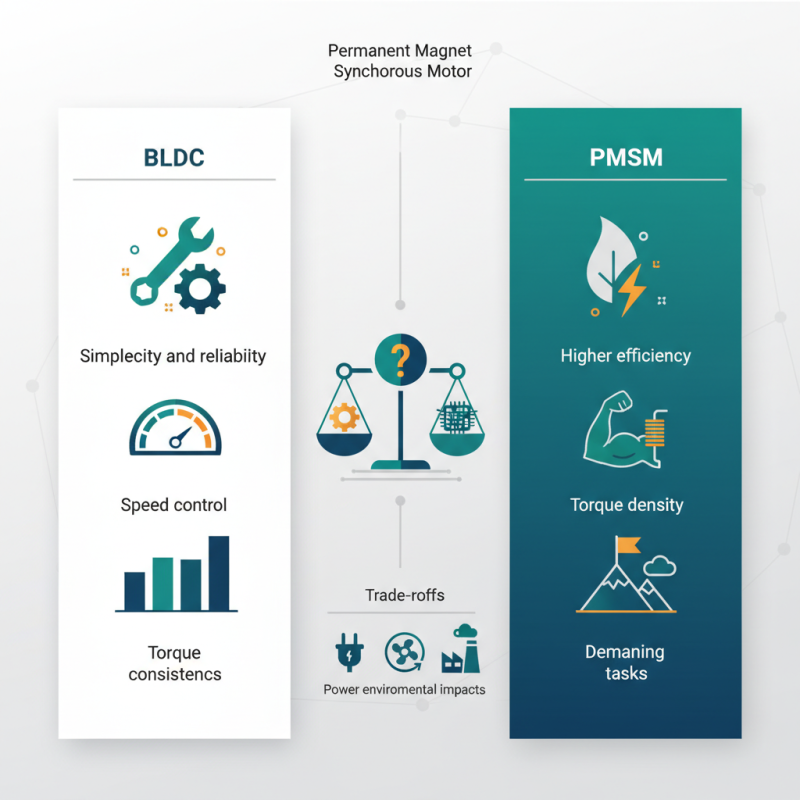
BLDC motors are widely used for their simplicity and reliability. They perform well in applications that require speed control and torque consistency. On the other hand, PMSMs offer higher efficiency and torque density, making them suitable for demanding tasks. It is essential to consider your specific requirements when choosing between these two types. However, what works for one application may not work for another.
Understanding these differences can be complex. Both motor types come with trade-offs, requiring careful consideration. Factors like power requirements and environmental impacts play significant roles in the decision-making process. By assessing your needs, you can make an informed choice that aligns with your goals and resources.
Understanding the Basics of BLDC and PMSM Motors
When selecting between Brushless DC (BLDC) and Permanent Magnet Synchronous Motors (PMSM), understanding their fundamentals is essential. Both types of motors operate under similar principles, but their designs and applications vary significantly. BLDC motors typically have a simpler construction. They are lightweight and efficient for many applications. On the other hand, PMSMs excel in high-performance situations, offering better torque and reliability, particularly in industrial settings.
Consider your specific application when making a choice. For example, if you need a motor for a handheld device, a BLDC might suffice due to its compact design. However, for electric vehicles requiring high torque, PMSM is likely better. Think about your system's compatibility and the required control methods. Each motor has unique characteristics that affect performance.
Tips: Evaluate the efficiency ratings. A higher rating generally means less energy wasted. Don't overlook the noise levels produced by each type. Sometimes, the quieter choice is essential, especially in consumer electronics. Lastly, consider the maintenance requirements. BLDC motors often require less maintenance, making them appealing for long-term use.
Key Differences Between BLDC and PMSM Motors
When selecting between Brushless DC (BLDC) and Permanent Magnet Synchronous Motors (PMSM), understanding their key differences is essential. Both motor types are popular in modern applications, but they serve different purposes. BLDC motors typically have simpler structures and can be more cost-effective. They are commonly used in many consumer appliances, such as drones and electric bikes. Their advantages lie in energy efficiency and low maintenance needs. However, their speed control can be less precise compared to PMSMs.
PMSMs, on the other hand, deliver higher performance under certain conditions. They excel in applications requiring precise speed and torque control, such as industrial automation. The construction of PMSMs allows them to operate efficiently across a broader range of speeds. But they can be more complex and expensive to implement. Additionally, using PMSMs often demands more sophisticated control systems, which may not be feasible for all users.
It's crucial to weigh these factors based on specific application needs. For example, a hobbyist may prefer a BLDC for its simplicity, while a manufacturer might invest in a PMSM for its performance benefits. Understanding the trade-offs between cost, efficiency, and control can guide you toward the best choice.
Factors to Consider for Your Specific Application
When choosing between Brushless DC (BLDC) motors and Permanent Magnet Synchronous Motors (PMSMs), specific application needs are crucial.
BLDC motors excel in applications requiring high torque at low speeds. They are often favored in robotics and automation, where precision is essential.
In contrast, PMSMs offer higher efficiency and performance in high-speed applications like electric vehicles. According to a 2022 market report, PMSMs can achieve up to 95% efficiency under optimal conditions, outperforming BLDC motors in energy consumption.
Consider the control requirements for your application as well.
BLDC motors typically utilize simpler control systems, making them easier to integrate into less complex applications.
They are also generally more compact, which is an advantage in space-constrained environments.
However, PMSMs require more sophisticated control systems, enabling them to handle more dynamic performance needs.
A balance between complexity and performance must be evaluated according to your project's demands.
Another critical factor is the cost of implementation.
BLDC motors are often less expensive initially but may incur higher maintenance costs due to wear in their commutation systems.
Conversely, PMSMs tend to have higher upfront costs but lower maintenance and operational costs over time.
The choice should reflect not just the initial investment but the long-term operational efficiencies sought.
Ultimately, each option has trade-offs that may not suit all situations; careful consideration of these factors is essential.
Cost Analysis of BLDC vs. PMSM Motors
When assessing BLDC and PMSM motors, cost is a major consideration. BLDC motors tend to be more affordable initially due to simpler construction and lower component costs. According to a report by the International Energy Agency, BLDC motors can be up to 15% cheaper than PMSM options for industrial applications. However, the savings may not be as significant when considering long-term efficiency and maintenance.
PMSM motors often require a higher upfront investment. However, they provide better efficiency in various operational conditions. The average efficiency of PMSM motors can reach up to 95%, compared to around 85% for BLDC motors. This increased efficiency translates to lower energy costs over time. A study from the U.S. Department of Energy suggests that for applications requiring continuous running, the energy savings of PMSM motors can outweigh their initial cost.
Furthermore, durability is another factor. BLDC motors may require more frequent maintenance due to component wear, which adds to lifecycle costs. On the other hand, PMSM motors generally offer robust performance with less frequent service requirements. It’s important to weigh these aspects against your specific operational needs to make an informed decision.
Cost Analysis of BLDC vs. PMSM Motors
The bar chart above illustrates the average cost comparison between Brushless DC (BLDC) motors and Permanent Magnet Synchronous Motors (PMSM). As shown, BLDC motors are generally less expensive than PMSM motors, making them a cost-effective choice for various applications.
Long-Term Performance and Maintenance Considerations
When selecting between Brushless Direct Current (BLDC) motors and Permanent Magnet Synchronous Motors (PMSM), long-term performance and maintenance are crucial factors. Both motor types offer efficiency, but their durability can differ significantly. According to the International Energy Agency (IEA), energy efficiency in electrical motors can influence operational costs by up to 30% over a device's lifetime. Hence, understanding their lifespan and maintenance needs is vital.
BLDC motors generally require less maintenance due to their simpler design. They have fewer moving parts than PMSMs, reducing mechanical wear. However, PMSMs often operate at higher efficiency levels, making them more suitable for demanding applications. The average lifespan of a BLDC motor can reach 15,000 hours under standard conditions. In contrast, PMSMs can last up to 20,000 hours but may demand more frequent inspections to ensure optimal performance.
It's essential to weigh these factors against the intended application. A motor's longevity hinges on proper care. Ignoring routine maintenance can lead to unexpected failures. The U.S. Department of Energy emphasizes that regular checks can prevent up to 80% of potential issues. Each choice has its trade-offs, and careful evaluation based on expected use is vital to making an informed decision.
How to Choose Between BLDC and PMSM Motors for Your Needs? - Long-Term Performance and Maintenance Considerations
| Feature |
BLDC Motors |
PMSM Motors |
| Efficiency |
85% - 90% |
90% - 95% |
| Torque Density |
Moderate |
High |
| Speed Range |
Wide |
Moderate |
| Maintenance |
Low |
Low to Moderate |
| Cost |
Lower |
Higher |
| Control Complexity |
Simple |
Complex |
| Applications |
Home Appliances, Fans |
Industrial Drives, Electric Vehicles |
Conclusion
Understanding the distinctions between BLDC (Brushless DC) and PMSM (Permanent Magnet Synchronous Motor) is crucial for selecting the right motor for specific needs. The key differences lie in their construction and operational characteristics. BLDC motors tend to provide higher efficiency at lower speeds, while PMSM motors are known for their superior torque performance and smoother operation at high speeds.
When considering what is the difference between BLDC and PMSM motor, factors such as application requirements, cost, and long-term maintenance should be evaluated. BLDC motors generally have lower upfront costs but may require more complex control systems, whereas PMSMs can offer better performance in applications where precision and reliability are critical. Ultimately, a thorough cost analysis and understanding of long-term maintenance will guide the choice between these two motor types, ensuring optimal performance for the intended application.
 Sweg Motor
