Choosing between China’s top BLDC and PMSM motors requires more than comparing catalog speed, voltage, or price. Engineers often ask, “what is the difference between bldc and pmsm motor,” but the answer depends on control method, rotor magnets, efficiency targets, and operating conditions. A motor on a specification sheet may look impressive. Real performance appears under load, heat, vibration, and repeated starts.
BLDC motors commonly use trapezoidal back electromotive force and simpler six-step commutation. They can deliver strong starting torque and practical cost advantages. PMSM motors usually use sinusoidal control and provide smoother torque, lower acoustic noise, and refined efficiency. This difference becomes visible in a warehouse fan, an electric pump, or a compact compressor. Listen closely. Poor commutation can create a noticeable hum.
China has many capable motor manufacturers, but quality is not uniform. Experienced buyers should review winding consistency, magnet retention, bearing quality, controller matching, thermal testing, and efficiency curves. Factory samples should be tested at the intended duty cycle, not only at no-load speed. Details matter. A reliable supplier can explain its materials, inspection process, test equipment, and failure data.
There is no universal winner. A BLDC motor may suit a cost-sensitive actuator with straightforward control. A PMSM may be better for quiet equipment requiring precise speed regulation. Yet this boundary is not always clean. Some products use overlapping designs and marketing terms. That can confuse even careful buyers. The best decision comes from measured torque, temperature rise, noise, efficiency, and service expectations. This guide examines those differences and the practical trade-offs behind China’s leading motor options.
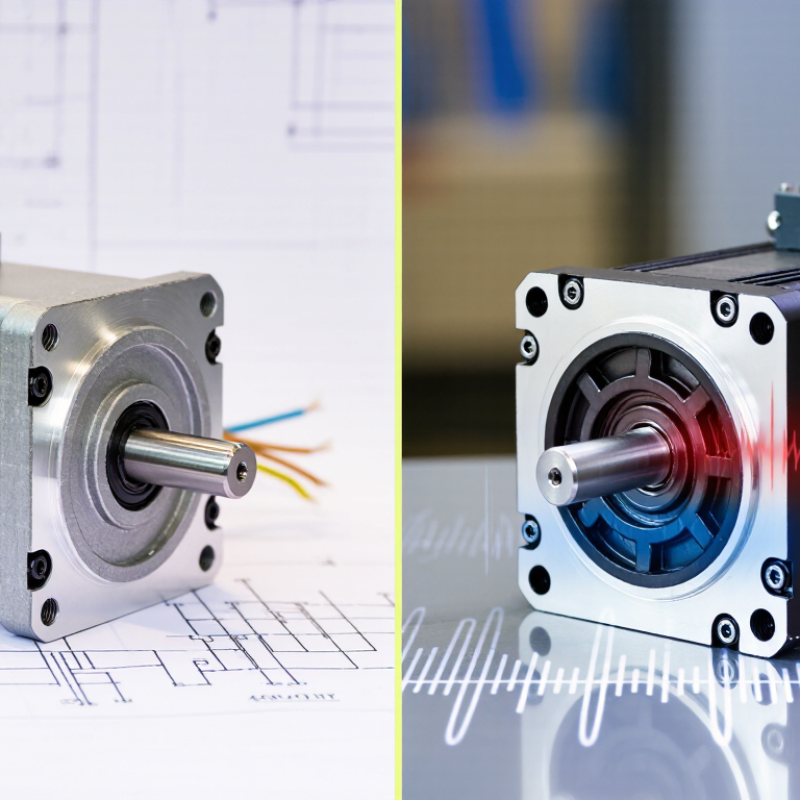
BLDC and PMSM Defined: Topology, Back-EMF, and IEC 60034-30-1
BLDC and PMSM motors share a permanent-magnet rotor, but their electrical behavior differs. A BLDC motor commonly uses trapezoidal back-EMF and six-step commutation. Its phase currents switch in rectangular blocks. A PMSM usually produces sinusoidal back-EMF and uses smoother sinusoidal currents. The distinction is practical, not absolute. Winding design and controller settings can blur the boundary.
The topology affects torque ripple, acoustic noise, and control complexity.
BLDC motors can deliver strong starting torque with simpler position logic. PMSM drives normally require more accurate rotor-angle estimation, but they can provide quieter rotation and lower ripple. Real factory measurements matter. Incorrect commutation timing can erase the expected efficiency advantage. The IEA’s Energy Efficiency 2023 analysis places motor-driven systems at roughly half of global electricity consumption, so small losses become expensive at scale.
IEC 60034-30-1 defines IE efficiency classes for specific line-operated AC motors and synchronous motor categories. It does not automatically classify every inverter-fed BLDC or PMSM as IE3 or IE4. Converter-fed variable-speed machines may require other test conditions, including IEC 60034-30-2. Engineers should compare rated load, speed, voltage, controller losses, and test temperature. One label is not enough. The U.S. Department of Energy’s Motor Systems Market Assessment also shows that system-level savings depend heavily on controls and operating profiles, not motor efficiency alone. The standard’s boundary can be easy to misunderstand.
Electronic Commutation, Torque Ripple, Noise, and Speed-Control Performance
BLDC and PMSM motors both use electronic commutation instead of brushes. The key difference is their back-EMF waveform and control method. A typical BLDC motor uses trapezoidal back EMF with six-step switching. A PMSM usually uses sinusoidal back EMF with field-oriented control. This distinction matters during acceleration, loaded operation, and low-speed positioning.
Six-step commutation can create noticeable torque ripple, especially near phase transitions. You may feel this as small jerks in a conveyor or hear a faint switching hum. PMSM control normally produces smoother current changes and lower torque ripple. It also supports accurate speed regulation and stable torque at low speed. However, the result depends heavily on rotor position feedback, current sensors, software tuning, and inverter quality. The motor name alone is not enough.
Noise is another practical separator. BLDC motors can be economical and responsive, but their commutation harmonics may increase acoustic noise. PMSM systems are often quieter, particularly when the controller uses high-resolution feedback and optimized current angles. Yet “quiet” is not guaranteed. Mechanical imbalance, bearing condition, PWM frequency, and mounting stiffness can dominate the final sound. In testing, measure speed error, torque ripple, and noise under the same load. A simple no-load test can mislead. China’s motor suppliers offer both structures, but buyers should request waveform data, thermal curves, and controller compatibility before choosing.
Efficiency Comparison: 80–90% BLDC Versus 90–97% PMSM at Rated Load
China Top BLDC vs PMSM Motors: What Is the Difference?
At rated load, BLDC motors commonly reach 80–90% efficiency, while PMSM motors often achieve 90–97%. This gap can matter in pumps, conveyors, compressors, and electric mobility equipment. A 5% improvement may reduce heat, battery demand, and cooling requirements during long operating hours. The actual result depends on motor size, winding quality, magnets, bearings, and controller settings.
BLDC motors usually use trapezoidal back electromotive force and simpler electronic commutation. Their design can be cost-effective and practical for fans, tools, and compact machines.
PMSM motors generally use sinusoidal control and produce smoother torque. They often perform better under continuous rated-load conditions, where reduced copper and iron losses become more valuable. The difference is noticeable.
Still, efficiency figures need careful reading. A motor listed at 97% may reach that number only at one speed, voltage, and load. Testing at partial load can produce a very different result. In field measurements, wiring loss and controller efficiency are sometimes ignored. That is a weakness in many comparisons. Engineers should request a complete efficiency map, temperature data, and test conditions before choosing a motor. I would not select PMSM solely from a headline percentage. A well-designed BLDC system can outperform a poorly matched PMSM system in real equipment.
China’s GB/T 18613-2020 Standard and IE4 Motor-Efficiency Classes
China Top BLDC vs PMSM Motors: What Is the Difference?
BLDC and PMSM motors both use permanent magnets, but their control methods differ. BLDC motors usually use trapezoidal back-EMF and six-step commutation. PMSM motors generally use sinusoidal currents for smoother torque and lower noise. In real projects, the boundary is less tidy. Some modern controllers make their performance look surprisingly similar.
China’s GB/T 18613-2020 mainly covers three-phase asynchronous motors, so it should not be applied automatically to every BLDC or PMSM motor. Its efficiency grades provide an important reference for motor selection in China. IE4 represents a higher efficiency class under international classification practice, but an IE4 claim must match the motor type, rated output, test method, and operating conditions. A motor may perform well at rated load yet lose efficiency during frequent speed changes. That distinction matters.
Tips: Check the certificate, test report, rated voltage, duty cycle, and control system together. Ask whether efficiency was measured with the drive included. Compare losses at 25%, 50%, 75%, and 100% load, not only at full load. Field measurements often reveal installation errors, poor tuning, or oversized motors. I would not choose a motor from the IE4 label alone. Small details matter.
China Top BLDC vs PMSM Motors: What Is the Difference?
BLDC and PMSM motors both use permanent magnets, but BLDC motors are typically controlled with trapezoidal back-EMF commutation, while PMSM motors generally use sinusoidal control and produce smoother torque. Motor efficiency depends on the design, operating point, controller, and load—not only on the motor type.
The chart shows reference minimum efficiency values for four-pole, 50 Hz motors across selected power ratings. GB/T 18613-2020 defines efficiency requirements through IE efficiency classes; IE4 represents a higher efficiency level than IE3 and IE2. The applicable value should be confirmed against the exact rated power, pole number, frequency, and test conditions.
Selecting BLDC or PMSM by Duty Cycle, Cost, Power Density, and Reliability
China Top BLDC vs PMSM Motors: What Is the Difference?
Choosing between BLDC and PMSM motors depends on the machine’s real duty cycle. BLDC motors commonly use trapezoidal back EMF and six-step commutation. They often reduce controller cost and suit pumps, fans, tools, and intermittent loads. PMSM motors use smoother sinusoidal control, usually with field-oriented control. This can deliver lower torque ripple, quieter operation, and higher power density. For continuous duty, PMSM may manage heat and efficiency better. That advantage matters in compact equipment with limited cooling space.
Tips: Measure the actual load profile, not only the rated power. Record start-up current, running temperature, speed changes, and daily operating hours. A low-cost BLDC motor can become expensive if it needs oversized cooling or frequent replacement. PMSM systems may cost more initially, but their efficiency can reduce energy losses over years. Check encoder requirements, controller compatibility, bearing life, and insulation ratings before selecting a motor.
Reliability depends on the complete system. A well-cooled BLDC motor may outlast a poorly designed PMSM installation. In field testing, temperature often reveals more than catalog efficiency. Dust, vibration, frequent starts, and sudden load changes also affect service life. The choice is rarely perfectly clean. Engineers may favor BLDC for simple control, then reconsider after testing noise and heat. PMSM is not automatically better. Select the motor that matches the duty cycle, control budget, and maintenance conditions.
FAQS
BLDC motors commonly use trapezoidal back EMF and six-step commutation. PMSM motors usually use sinusoidal control. This difference affects smoothness, noise, and low-speed control.
PMSM motors generally produce lower torque ripple with properly tuned field-oriented control. BLDC motors may create small jerks near phase transitions. You might feel them on a conveyor.
No. PMSM motors can be quieter, especially with accurate feedback and optimized current angles. Poor mounting, worn bearings, or unsuitable PWM frequency can still create noise. Quietness is not guaranteed.
BLDC motors commonly reach about 80–90% efficiency. PMSM motors often reach about 90–97% at rated conditions. Actual results depend on speed, load, winding quality, and controller settings.
Yes, sometimes. A well-matched BLDC system can beat a poorly matched PMSM system. Controller compatibility and cooling matter. A catalog percentage is not enough.
PMSM motors may perform better during long operation because they often produce less heat and higher efficiency. This helps pumps, conveyors, and compact machines. Test the real duty cycle.
BLDC motors can suit fans, tools, pumps, and intermittent loads. They often use simpler control and may reduce initial system cost. They are not automatically inferior.
Measure starting current, running temperature, speed error, torque ripple, and noise under the same load. Record daily operating hours too. No-load testing can mislead.
Check encoder needs, current sensors, inverter quality, insulation ratings, and bearing life. Also inspect cooling, vibration, dust exposure, and mounting stiffness. Small details matter.
Not necessarily. A low-cost motor may need larger cooling equipment or more maintenance. A higher initial cost can reduce energy losses over time. The comparison remains imperfect.
Conclusion
Understanding what is the difference between bldc and pmsm motor begins with their magnetic topology and back-EMF waveform. BLDC motors typically use trapezoidal back-EMF and electronic commutation, while PMSM motors generally produce sinusoidal back-EMF and rely on sinusoidal or vector control. These differences influence torque ripple, acoustic noise, speed regulation, and overall operating smoothness. In many applications, BLDC efficiency is approximately 80–90%, whereas PMSM efficiency may reach about 90–97% at rated load, depending on the design and control system.
Efficiency classification is also affected by IEC 60034-30-1 and China’s GB/T 18613-2020 standard, including IE4 requirements for qualifying motor systems. BLDC is often selected for lower initial cost, simpler control, and moderate-duty applications. PMSM is usually preferred when high power density, excellent efficiency, quiet operation, and long-term reliability are priorities. The best choice should be based on duty cycle, load profile, required speed range, system cost, thermal limits, and maintenance expectations.
 Sweg Motor
